Fecal Calprotectin’s Clinical Value Reaffirmed: A Novel Early Diagnostic Tool for Necrotizing Enterocolitis in Preterm Infants
Necrotizing Enterocolitis (NEC) is one of the most critical intestinal emergencies affecting preterm infants, characterized by challenging early diagnosis and rapid disease progression. As a non-invasive, intestinal-specific inflammatory biomarker, fecal calprotectin (FC) has attracted extensive research attention in recent years. In July 2025, a single-center study conducted by Zunyi First People’s Hospital was published in Frontiers in Pediatrics, systematically evaluating the efficacy of FC in the early diagnosis and severity assessment of NEC among preterm infants. Notably, the calprotectin test kits adopted in this research were supplied by Xiamen Wiz Biotech Co., Ltd., further validating the clinical application value of the company's non-invasive intestinal inflammation detection products.
Research Background
NEC predominantly occurs in preterm infants with a high mortality rate. Surviving patients may suffer severe long-term complications including short bowel syndrome, intestinal stricture, and neurodevelopmental disorders. Current NEC diagnosis relies on clinical manifestations, laboratory tests and abdominal X-ray imaging, while high-sensitivity and high-specificity early biomarkers remain scarce.
Derived from neutrophils, fecal calprotectin rises drastically during intestinal inflammation. Its non-invasive sampling and convenient testing make it a promising candidate for routine NEC screening.
Study Design
Study Subjects: NEC group: 84 preterm infants, Feeding intolerance group: 84 preterm infants, Healthy control group: 168 preterm infants
Study Period: September 2021 – June 2024
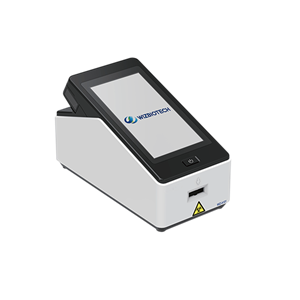
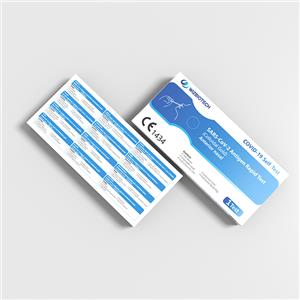
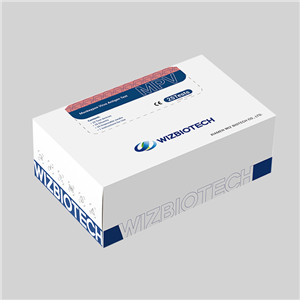
Detection Method: FC concentrations were measured via immunochromatographic assay using test kits manufactured by Xiamen Wiz Biotech Co., Ltd.
Statistical Analysis: ROC curve analysis, Spearman correlation analysis, non-parametric tests
Key Research Findings
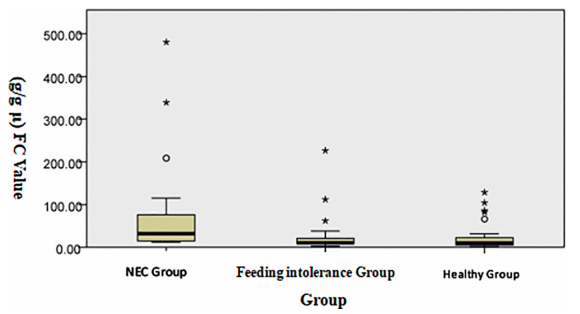
Significant FC elevation in NEC patients enables differentiation between NEC and non-NEC conditions.
The median FC level of the NEC group was markedly higher than that of the feeding intolerance group and healthy control group.
No statistically significant difference in FC levels was observed between the feeding intolerance group and healthy controls.
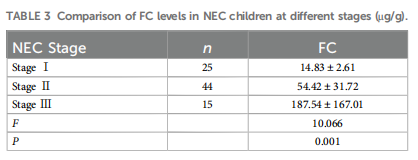
FC concentration positively correlates with NEC severity FC levels followed the ranking: Stage III > Stage II > Stage I (P < 0.05)
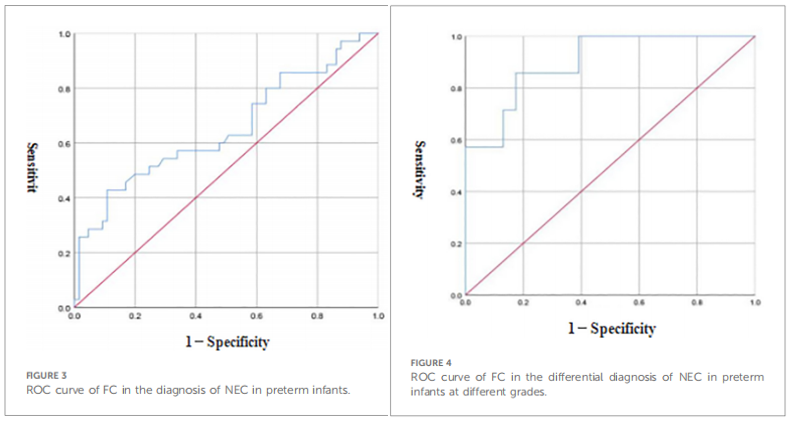
Diagnostic performance of FC for NEC (ROC Curve Analysis) ROC analysis identified the optimal FC cut-off values for general NEC diagnosis and moderate-severe NEC stratification as 8.40 μg/g and 53.50 μg/g respectively:
For general NEC diagnosis: AUC = 0.651, sensitivity = 42.86%, specificity = 89.23%
For moderate-severe NEC identification: AUC = 0.901, sensitivity = 85.71%, specificity = 82.61%
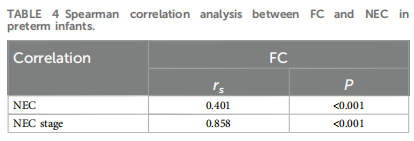
Correlation analysis Spearman correlation analysis confirmed that FC levels are positively correlated with both the incidence and severity of NEC in preterm infants.
Research Advantages & Clinical Significance
Non-invasive & easy sampling: Stool samples are readily accessible, supporting continuous monitoring for preterm neonates
Excellent repeatability: Calprotectin remains stable in feces with minimal degradation
Supports stratified clinical management FC levels above 53.5 μg/g indicate high risk of moderate-severe NEC, assisting clinical decision-making
Compensates for drawbacks of conventional testing: Traditional blood tests involve invasive sampling and poor specificity; FC provides an alternative non-invasive auxiliary diagnostic solution
Study Limitations
Single-center design with limited sample size Only 84 subjects were enrolled in the NEC group, which may introduce selection bias.
Lack of standardized testing protocols Cut-off values vary across manufacturers, preventing direct cross-brand result extrapolation.
Uncontrolled confounding factors such as postnatal age Previous studies have proven FC levels are associated with postnatal age, which was not fully adjusted in this trial.
Moderate AUC for general early NEC screening (0.651) FC alone has limited diagnostic power for early NEC, and combined biomarker testing is recommended
Summary
Fecal calprotectin serves as an effective auxiliary biomarker for NEC screening and severity evaluation in preterm infants, with outstanding predictive performance for moderate-severe NEC. Further multi-center, large-sample trials are required to establish standardized universal cut-off thresholds.